Why the difference matters in medicine reviews
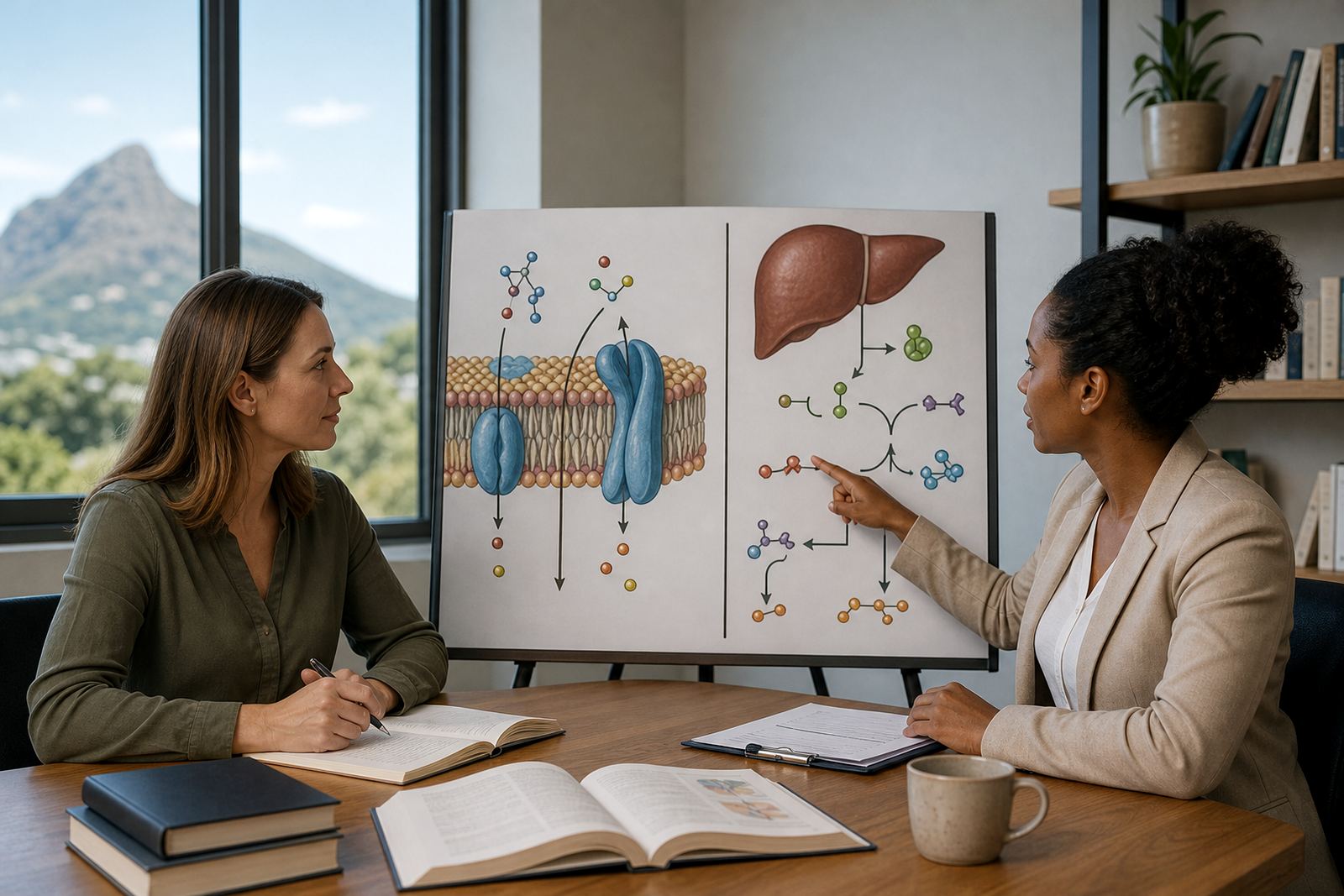
When a medicine behaves unexpectedly, the cause is not always the same. Sometimes the issue is metabolism, where an enzyme changes the chemical structure of a substance. At other times it is transport, where a protein helps move a substance into or out of a cell. Those two steps can happen in the same body system, but they are not the same process.
For a South African reviewer working through a prescription list, this distinction matters because the wording on labels, package inserts and literature can blur the picture. A note about a CYP450 enzyme does not tell you everything about a transporter, and a transporter note does not automatically explain enzyme activity. That is why careful reading helps avoid mixed-up conclusions.
What CYP450 enzymes actually do
CYP450 enzymes are a family of metabolic enzymes found mainly in the liver, and also in the gut wall. They help the body change many medicines, hormones and other compounds into forms that can be easier to clear. Some substances are activated, some are inactivated, and some are just altered along the way.
People often speak about CYP450 as if it is one single thing, but it is a group of related enzymes with different roles. In general terms, they help with biotransformation. They do not carry medicines through membranes. They act like chemical workers, not moving parts.
- They change the structure of certain medicines.
- They can be affected by inhibitors or inducers.
- They are part of phase 1 metabolism, alongside other enzyme systems.
What transporters do that enzymes cannot
Transporters are membrane proteins that move substances across cell barriers. They can help a medicine enter a cell, leave a cell, or move between tissues. Some transporters limit absorption in the gut, some shape distribution into organs, and some help with excretion through the liver or kidneys.
Unlike enzymes, transporters do not chemically alter the substance in the process. They move it. That sounds simple, yet the practical impact can be large. If a transporter is blocked, a medicine may stay in the wrong place or reach a different concentration than expected. In a review, that changes how you interpret the interaction even when the medicine name is familiar.
- They influence absorption, distribution and excretion.
- They can reduce or increase exposure without changing the molecule itself.
- They often work alongside enzymes, so both need checking.
A practical way to separate the two in a literature review
A useful habit is to ask two separate questions. First: does this substance get metabolised by a CYP450 enzyme or another enzyme pathway? Second: does it also rely on a transporter for movement across a membrane? Keeping those questions apart makes the review cleaner and helps prevent overstatement.
For example, a paper may mention reduced drug exposure. That does not tell you whether the cause was faster metabolism, lower absorption, or increased efflux. When reading the evidence, check whether the authors are discussing enzyme inhibition, enzyme induction, transporter inhibition, transporter competition, or a combination of these. Small wording differences matter here, especially in a clinical brief.
- Look for the exact protein named, not just the medicine class.
- Check whether the effect was in the gut, liver, kidney, or blood-brain barrier.
- Separate chemical change from movement across a membrane.
How both systems can shape the same interaction
Many medicines pass through more than one control point. A compound may be absorbed by one transporter, metabolised by a CYP450 enzyme, and then moved out again by another transporter. That layered setup is normal biology. It also explains why interaction charts sometimes feel confusing when one drug appears in several pathways.
In practice, it helps to avoid the habit of blaming every interaction on CYP3A4 alone. Enzymes are important, but they are not the whole story. Transporters can alter exposure before a medicine even reaches the liver, and they can also affect elimination later on. For clinicians in Cape Town or Johannesburg reviewing complex medicine lists, that broader view can make the summary more accurate.
It is also a reminder that herbal products, supplements and food components may affect more than one pathway. The safest approach is to read broadly, then speak to the patient’s own doctor or pharmacist about the full medicine list and any possible interaction concerns.
A local example from everyday clinic work
Consider a patient in Rondebosch collecting chronic medicine from a community pharmacy after a private consultation. The patient also mentions a new wellness tonic, a prescribed antibiotic and a regular heart medicine. A quick check of one enzyme pathway is not enough. The reviewer needs to ask whether the antibiotic affects a CYP450 enzyme, whether the heart medicine depends on a transporter, and whether the tonic has any known interaction potential at all.
That is the kind of practical question South African clinicians and pharmacists face every day, whether the case comes from Cape Town, Durban or Bloemfontein. The point is not to guess the outcome. The point is to separate the pathways, read the evidence carefully, and refer the medicine question back to the treating doctor or pharmacist when needed.
- Check enzyme pathway, transporter pathway, and timing of use.
- Note whether the concern is absorption, metabolism or clearance.
- Keep the summary plain enough for clinical handover.
How CYP450 Insights frames the difference for readers
Our work focuses on clear educational writing for clinicians, pharmacists and wellness practitioners who need a careful summary rather than a crowded page of jargon. That means we separate enzyme language from transporter language, explain where each one matters, and keep the wording grounded in established general knowledge. No diagnosis, no treatment advice and no dosing advice, just useful context for discussion with the patient’s own doctor or pharmacist.
Whether the brief is for a journal scan, a training talk or a case note development project, the goal is the same: make the science readable without flattening it. Enzymes and transporters are different tools in the body, and once that is clear, the rest of the interaction picture is easier to read.