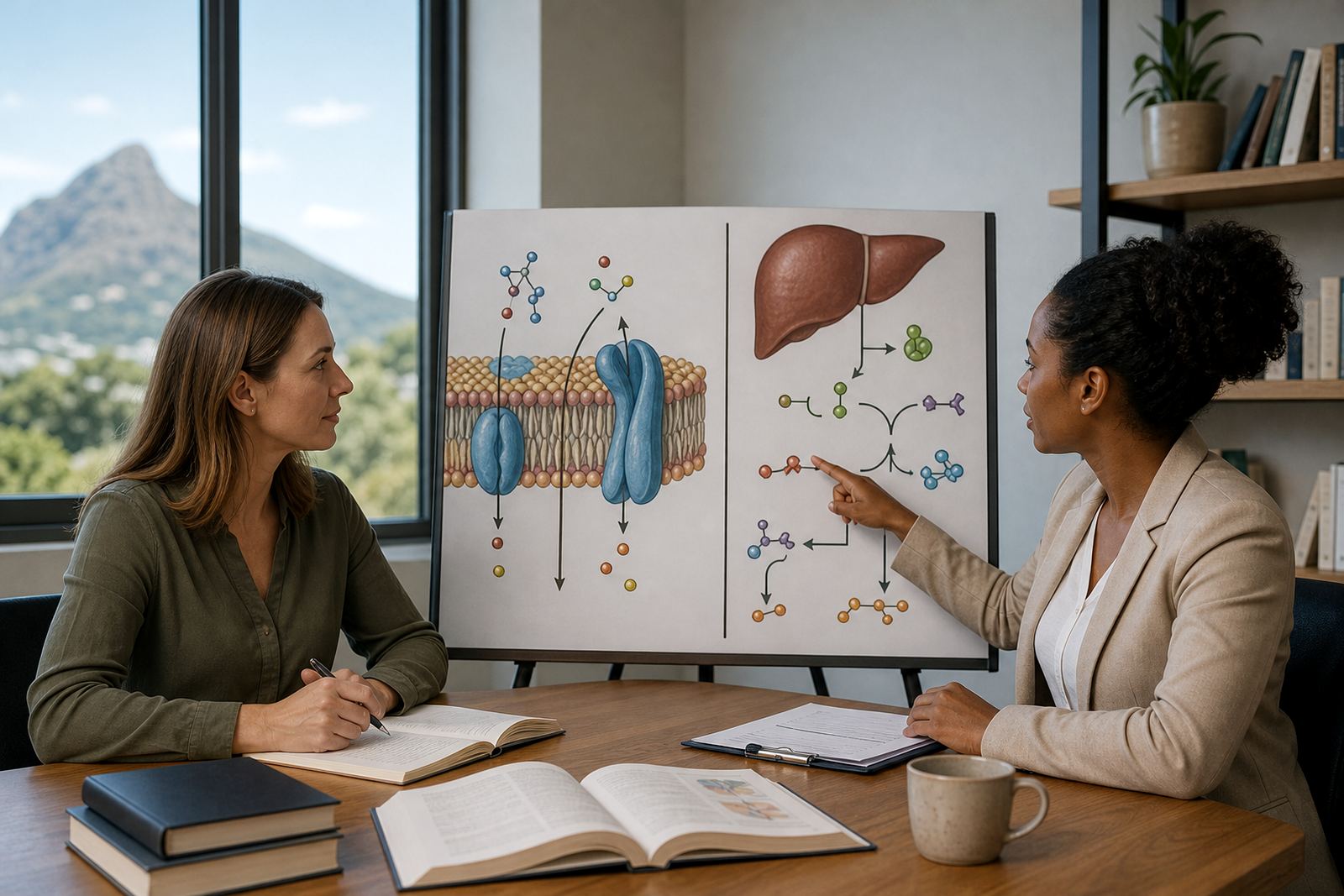
Why CYP450 education needs a South African lens
CYP450 enzymes are central to how the body processes many medicines and some nutrients, but the teaching around them often assumes one standard patient and one standard setting. South African practice is more varied than that. Patients may collect medicines in a private practice, a public sector clinic, a pharmacy in a busy shopping centre, or a hospital follow-up queue that runs across two transport connections and a missed lunch. The science stays the same, but the education has to account for different counselling time, language needs and access to reference material.
For clinicians, pharmacists and wellness practitioners, the practical question is usually not whether CYP450 matters, but how to explain it simply. People often need to understand why one medicine may work differently from another, why interactions can happen, and why a medicine review matters when several products are being used together. That includes prescribed medicines, over-the-counter items and some herbal products, all of which may influence how an enzyme pathway behaves.
What practitioners usually need to know first
In South African settings, educational material works best when it answers the common questions first. Which medicines are metabolised by CYP enzymes? Which combinations are known to interact in general terms? Which patient groups may need extra caution, and what information should be checked before a final decision is made? A plain summary can help staff move from vague concern to a clear next step without overcomplicating the science.
- Explain that CYP450 refers to a family of enzymes, not one single pathway.
- Separate drug metabolism from diagnosis, because the science does not replace clinical assessment.
- Flag that genetics can influence enzyme activity, but results must be interpreted carefully.
- Remind teams that interactions can involve medicines, supplements and some foods.
- Encourage review of the full medicine list, not only the newest prescription.
That last point matters in practice. A patient may mention a blood pressure tablet, a reflux medicine and a sleep aid only after a careful follow-up question. If the full list is not gathered, the educational message becomes too thin to be useful.
Local practice examples from Cape Town to Bloemfontein
A useful local example is a pharmacist in Claremont reviewing a repeat prescription for a patient who also uses a traditional remedy and an occasional cough mixture. The pharmacist does not need to turn the consultation into a lecture, but does need a clear interaction overview and a simple way to explain why the combination should be checked. The same applies in a GP rooms setup in Pretoria, a wellness clinic in Durban or a teaching ward round in Bloemfontein. The setting changes, but the education problem is similar: people need the information quickly, clearly and without jargon.
South African educators also work across different patient languages and different levels of health literacy. A brief in English may need to be followed by a spoken explanation in another language, or by a one-page handout that a family member can take home. In some communities, travel time and municipal service interruptions mean that follow-up is not easy, so the first explanation must be practical enough to be remembered later. That is one reason plain-language summaries matter.
- Use short sentences when explaining enzyme pathways to patients or support staff.
- Give examples that fit real practice, such as multiple medicines collected from different sources.
- Keep the focus on review and referral, not on making the patient self-manage alone.
- Where possible, provide written notes that can be read again later when memory is under pressure.
Why plain language beats technical overload
CYP450 teaching can become too technical very quickly. Terms like induction, inhibition and polymorphism are useful in professional discussion, but they can lose the room if they are not translated into everyday meaning. A busy practitioner may only have a few minutes to explain why a medicine interaction is possible, so the wording needs to be accurate and brief.
Plain language does not mean watered down science. It means choosing the clearest route through the science. For example, instead of saying a medicine is “affected by multiple hepatic pathways”, a short brief can explain that the body uses certain enzymes to change how the medicine is handled, and that another substance may speed this up or slow it down. That is enough for most educational purposes, and it leaves room for the clinician or pharmacist to decide what to do next.
Educational briefs, journal scans and slide notes are most useful when they are built for practical use, not academic showmanship. A well written summary helps the team avoid misunderstandings, especially when the topic touches on genetics, metabolism and interaction risk all at once.
How training talks support clinics, pharmacies and wellness teams
Training talks are often the bridge between the literature and the consulting room. A short session can give a team shared language, common caution points and a better sense of when to escalate a question to a doctor or pharmacist. That can be especially useful for newer staff, student groups and multidisciplinary teams who all need the same basic framework.
In a South African context, good training also has to fit real working conditions. Load-shedding can interrupt a session, internet access may be patchy, and a team might be learning between patient arrivals rather than in a long protected block. For that reason, training material should work in small segments and still make sense if someone joins late or returns to it the next day. We would also rather give a useful handout than a stack of dense slides that nobody reads again.
- Keep each talk centred on one clear learning aim.
- Include interaction overviews for the most common medicine classes discussed by the team.
- Build in question time so local practice concerns can be raised.
- Use examples that suit public sector and private sector workflows alike.
What careful CYP450 education should never promise
Good CYP450 education is careful about its limits. It should never promise that enzyme information alone can predict a person’s full response to treatment. It should not imply diagnosis, and it should not replace the judgement of the doctor or pharmacist caring for the patient. Genetics, age, liver function, other medicines, food intake and general health all matter, and a teaching note should say so plainly.
The best material gives people a way to think, not a shortcut to certainty. That is important in South Africa, where a single patient may move between different levels of care and collect medicines from more than one place. Education that stays honest about uncertainty is usually the most trustworthy kind.
For that reason, our article-level summaries focus on general science, practical interpretation and the habit of checking before acting. If a medicine question comes up, readers should speak to their own doctor or pharmacist about the medicines involved.