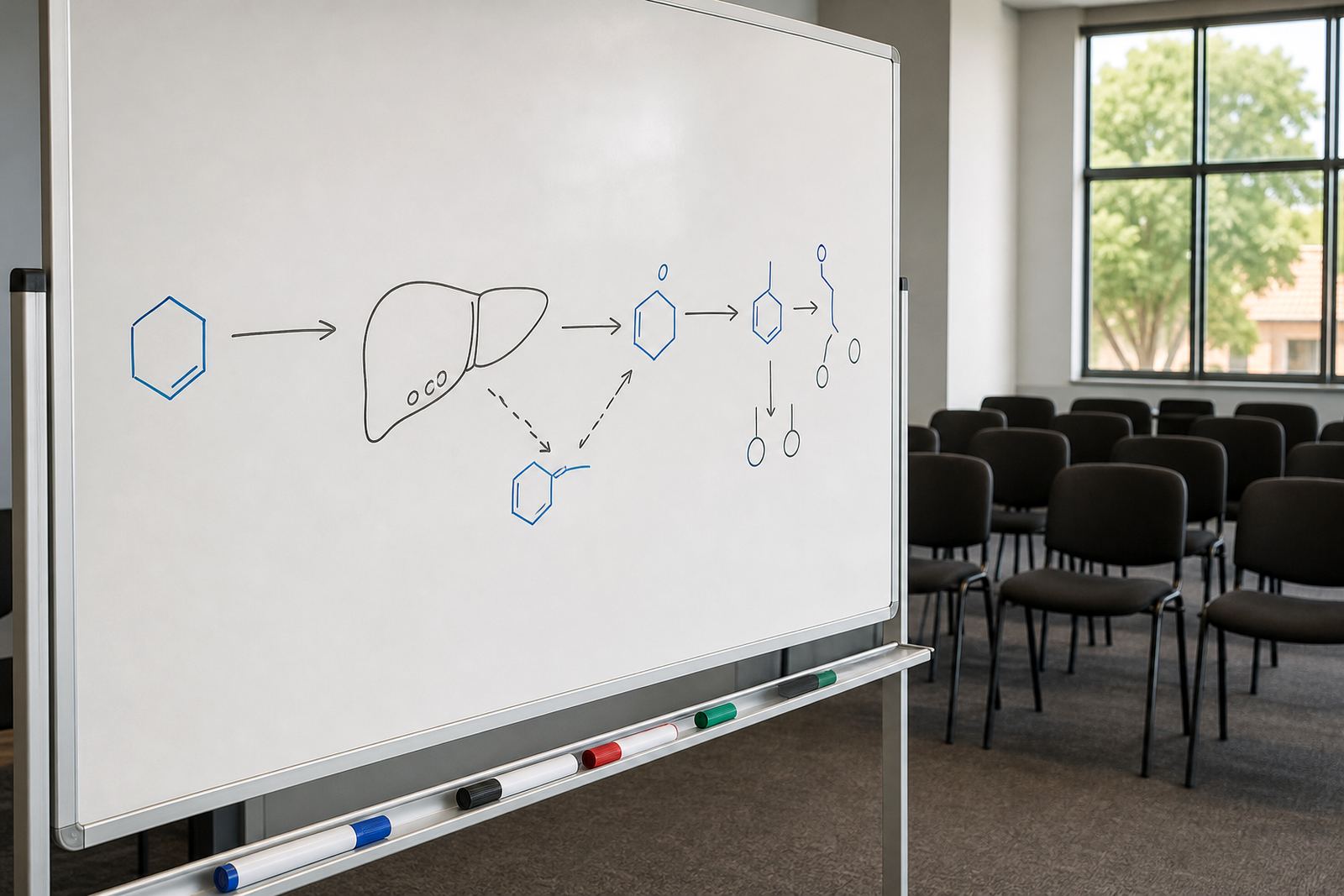
What this teaching brief covers
This brief explains the main Phase 1 reactions used in general pharmacology teaching, with a clear focus on oxidation, reduction and hydrolysis. It also shows where cytochrome P450 enzymes fit in, and where other enzyme systems may be involved. The aim is to make the science readable for mixed clinical groups without overstating what the pathways can tell you about an individual patient.
It is suitable for team learning, journal club prep and internal education where the goal is shared understanding rather than diagnosis. The content stays at an established, widely accepted level and does not give medical advice, dosing advice or treatment instructions. For medicine choices or changes, readers should speak to their own doctor or pharmacist.
How the content is structured
The brief is arranged so that a reader can move from basic chemistry to practical interpretation in a short teaching session. It can be used on its own or alongside a separate interaction overview when your group wants more context on a specific medicine class. The language is direct, with careful definitions and a focus on what matters in a South African practice setting.
- Clear definitions of oxidation, reduction and hydrolysis
- Simple explanation of how Phase 1 reactions alter drug structure
- Plain notes on common enzyme families involved in metabolism
- Teaching points for clinicians, pharmacists and education teams
- Reference list building for further reading and internal study
Where it suits best
This brief suits practices and learning teams that want a concise, grounded resource on drug metabolism. It is helpful for onboarding, CPD style discussion, case note development and curriculum support. Because it does not depend on local lab testing or patient-specific interpretation, it can be used in Cape Town, Johannesburg, Pretoria, Durban and Bloemfontein without any regional adaptation beyond your teaching context.
It works well for:
- Pharmacy and clinical teaching sessions
- Wellness practitioner education where medicines are discussed carefully
- Health team briefings on enzyme pathways and interaction basics
- Study groups that need a clean summary before reading primary literature
Options, sizes and delivery format
The brief is available in practical format options so teams can choose the level of detail they need. Smaller groups often prefer a short teaching summary, while larger teams may request a fuller version with expanded notes and a reference list. The content can also be adapted into slide deck writing for talks or workshops, if the same topic must be presented to different audiences.
- Short brief for a 15 to 20 minute teaching slot
- Standard brief for group learning and internal review
- Expanded brief with additional notes and references
- Plain language summary for non-specialist staff
- Training talk support with speaker notes and slide content
No power, gas or installation is required. The brief is supplied as a written educational resource, ready for use in meetings, workshops or self-study. If you are running an in-person session in Rondebosch, Claremont or Newlands, you only need a projector or printed copies, depending on how you teach.
Care, updating and servicing
Like any science teaching material, this brief should be reviewed from time to time so that the references stay current and the wording remains useful for your team. We recommend keeping it with your internal education files and checking it again before major teaching cycles or when your practice focus changes. That is especially useful if your group works across multiple sites and needs one shared version for everyone.
For ongoing use, the usual support options are:
- Content editing to keep terminology consistent
- Journal scans for follow-up reading on related enzymes
- Team workshops to discuss interpretation and wording
- Curriculum support for structured training programmes
There is no mechanical servicing. The practical upkeep is editorial, meaning the document is checked for clarity, accuracy of general science and alignment with your learning goals. If your team wants a revised version later, we can adjust the brief and reference list rather than starting over.
What to check when ordering
Before you request this brief, it helps to know who will read it and how much background they already have. A pharmacy team may want a little more detail on enzyme families, while a wellness education group may need a more basic explanation of why metabolism varies between medicines and between people. If the brief is going to be used in a formal talk, please also confirm the expected length and whether you need speaker notes.
Please check the following before ordering:
- Target audience and their level of science knowledge
- Preferred length, short, standard or expanded
- Whether you need a plain language summary as well
- Whether the brief must support a training talk or workshop
- Any specific medicines or enzyme pathways you want mentioned in general terms
- Reference style required for your internal records
Clients in South Africa can reach us through the enquiry form on our contact page. Dr Luyanda Mbeki oversees the team, with support from Ayesha Daniels, Pieter van Rooyen, Naledi Molefe, Sibusiso Khumalo and Taryn Naidoo across writing, analysis, education and editing.
Key facts
| Product type | Educational teaching brief |
|---|---|
| Topic | Phase 1 metabolism, including oxidation, reduction and hydrolysis |
| Audience | Clinicians, pharmacists and wellness practitioners |
| Format options | Short, standard and expanded brief |
| Use setting | Teaching sessions, journal clubs, workshops and internal training |
| Base | Rondebosch, Cape Town |