When dietitians ask for CYP450 support
Dietitians usually come to us when a client conversation goes beyond food alone and starts touching on medicines, supplements, herbal products or general wellness advice. CYP450 topics can come up around nutrient pathways, liver metabolism, polypharmacy and questions about why two people may respond differently to the same intake pattern. Our role is to turn that science into plain language without overstating what the enzymes can or cannot tell you.
In a South African practice, the need is often practical: a client in Cape Town may be using prescription medicine alongside over-the-counter products, while another in Johannesburg or Durban is asking whether a food pattern, supplement routine or fasting plan changes anything important. We help dietitians explain the general enzyme picture, then hand the medicine specific questions back to the doctor or pharmacist where they belong.
- General CYP450 education for client handouts and internal notes
- Interaction overviews for medicines, supplements and food related discussion
- Plain-language summaries for clinics, wellness rooms and team meetings
Typical materials and equipment for a dietetics team
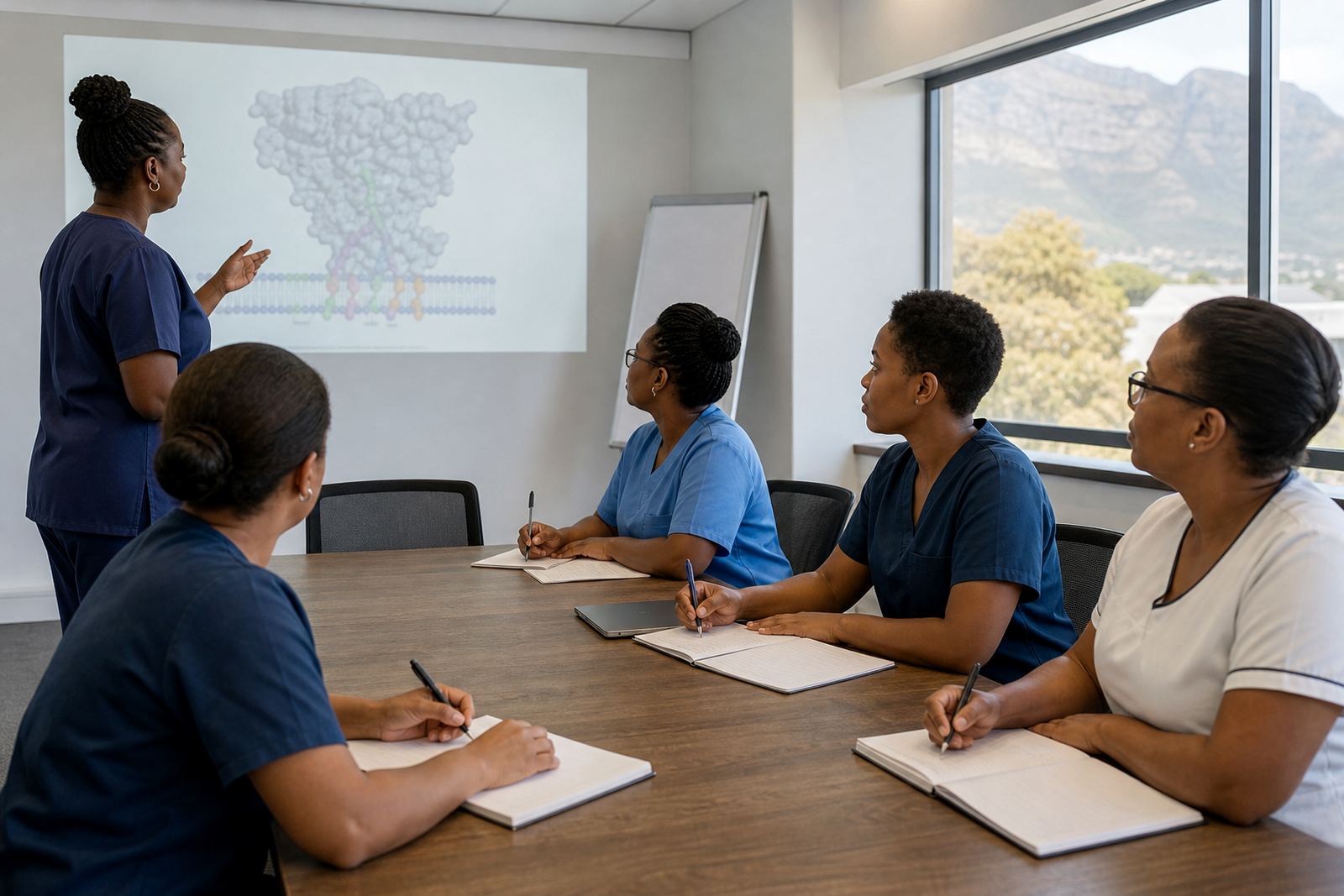
This service is content based, so the usual setup is simple. Most clients only need a reliable laptop or tablet, a stable internet connection, a printer for handouts and a quiet meeting space for training talks. If you run group education sessions, a projector or screen can help when the team wants to show a short slide deck on CYP450 basics, nutrient pathways and safe referral points.
For practices in Rondebosch, Claremont or Newlands, a small meeting room is usually enough. In busier centres, the best arrangement is often one consultation room for private discussion and one shared space for staff teaching. Coastal humidity in Cape Town can affect paper storage over time, so keep printed notes in sealed folders and avoid leaving reference packs near open windows. If your practice is in a larger building with load-shedding interruptions, battery backup for a laptop and router makes life easier.
- Laptop or tablet for reviewing literature and briefings
- Printer and filing trays for reference packs
- Projector or screen for training talks
- Backup power for short outages during sessions
- Secured storage for printed client education material
How to plan a CYP450 education session
Good planning starts with scope. A dietitian does not need every enzyme detail, only the parts that help explain general metabolism, nutrient pathways and the limits of interpretation. We usually structure the material so it begins with a short definition, then covers common interaction themes, then closes with clear referral guidance. That keeps the talk useful for clinicians, pharmacists and wellness practitioners without turning it into a pharmacology lecture.
For a team workshop, we suggest 30 to 60 minutes for a basic session and longer if your staff want discussion time. For a client-facing resource, one page is often enough, with a second page for references and clinic notes. In Pretoria, Bloemfontein or Durban, practices often prefer a hybrid approach: one live training talk, then a plain-language summary that can be reused by the whole team.
- Start with the question your team hears most often
- Use one page for core facts and one page for references
- Keep referral language simple: medicine questions go to the doctor or pharmacist
- Leave room for local practice notes and client handout updates
Common mistakes we help dietitians avoid
The most common mistake is overclaiming. CYP450 enzymes matter, but they do not explain every symptom, food response or supplement concern. Another issue is mixing educational content with personal medical advice. Our materials stay on the right side of that line and remind readers to speak to their own doctor or pharmacist about medicines.
We also see teams overload handouts with technical terms. That makes clients switch off. Better to explain that enzymes help process many substances, then note that individual responses vary. A third mistake is using one generic note for all audiences. A wellness practitioner may need a broader overview, while a pharmacist may want a tighter interaction summary and a stronger reference list. Slightly different wording makes a big difference.
- Avoid promising that CYP450 explains every reaction or intolerance
- Do not give dosing advice, diagnosis or medicine changes
- Keep terminology consistent across staff notes and client handouts
- Match the depth of detail to the audience in front of you
Budget ranges for South African practices
Budget depends on how much material you need and how many people need to use it. A small dietetics practice that wants one educational brief and a short training talk will usually spend far less than a multi-location group needing repeated updates, slide decks and reference lists. The figures below are general planning ranges in Rand, and final cost depends on complexity, turnaround time and the number of documents.
As a guide, a single plain-language summary or short interaction overview may sit in the lower range, while a fuller literature review with a trainer pack and reference support costs more. Practices in Cape Town, Johannesburg and Durban often also budget for staff time, printing and meeting room use. If you need materials for several branches, it is often more efficient to create one master document and then adapt it for local use.
- Short educational brief or summary: about R1 500 to R3 500
- Interaction overview with references: about R3 500 to R7 500
- Workshop support and slide deck writing: about R5 000 to R12 000
- Full literature review or multi-part content set: from about R8 000 upward
What dietitians usually receive from us
Our work for dietitians is built around careful reading and clear writing. Depending on your brief, we can prepare a literature review, an educational brief, a plain-language summary, a training talk outline, a journal scan or a reference list. We also help with curriculum support, content editing and case note development where a teaching file needs to be easier to follow. Nothing here replaces clinical judgement, it supports the team that is already doing the work.
Clients across Cape Town, Johannesburg, Pretoria, Durban and Bloemfontein often want one central contact and a predictable process. That is how we work too. The enquiry form on our contact page starts the conversation, then we agree the topic, audience and format. From there, Dr Luyanda Mbeki and the team can shape the material for your practice, whether you need a one-off brief or a set of notes for ongoing staff teaching.