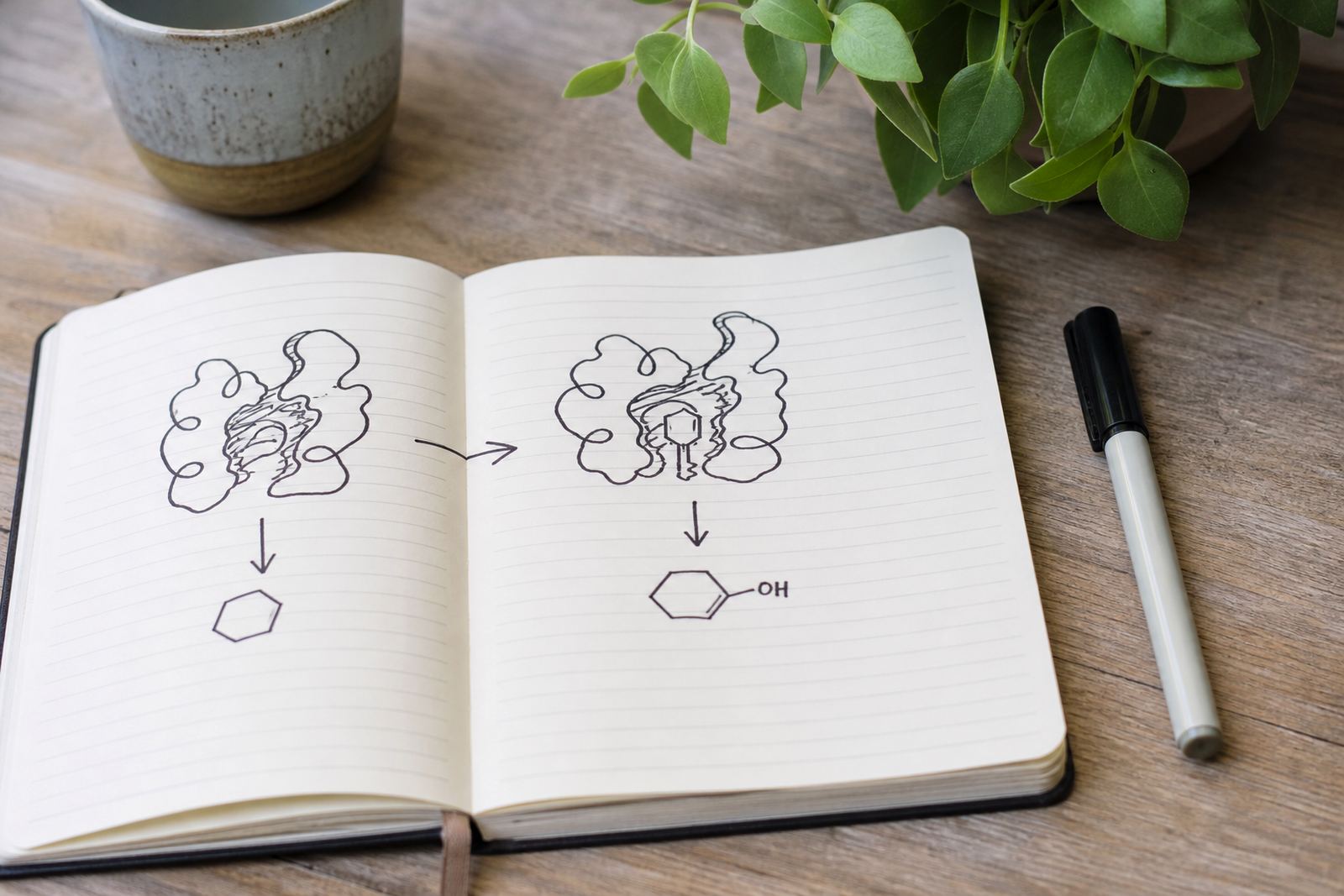


What enzyme inhibition means in CYP450 language
In simple terms, inhibition means one substance slows the activity of a CYP450 enzyme. That enzyme then works less efficiently for a period of time, so the body may process certain medicines more slowly. The key point is that inhibition is about reduced enzyme activity, not complete shutdown in most everyday situations.
When people hear the word inhibition, they sometimes assume the interaction is always dramatic. In practice, the effect depends on which enzyme is involved, how strongly it is inhibited, how long the inhibitor stays in the body, and whether the medicine is one that relies heavily on that pathway. A careful literature review will usually distinguish between mild, moderate and strong inhibition, because those labels matter.
Why inhibition language is easy to misunderstand
Interaction teaching often uses shorthand that can sound firmer than the evidence allows. A note may say a substance inhibits an enzyme, but that does not automatically mean a harmful outcome will happen in every person. It means the pathway can be affected, and the clinical relevance still needs to be checked against the specific medicine and the full context.
Inhibition language becomes confusing when it is mixed up with side effect warnings, absorption issues or liver disease. Those are different topics. It also helps to remember that not every CYP450 enzyme behaves the same way. CYP3A4, CYP2D6, CYP2C19 and others are often discussed together, but each has its own pattern of substrates, inhibitors and clinical importance.
For clinicians and pharmacists reading summaries, the practical question is usually this: does the change in enzyme activity matter enough to alter the expected effect of the medicine? That is where clear wording saves time and reduces misunderstanding.
How inhibition can change medicine response
If a medicine depends on a CYP450 enzyme for breakdown, inhibition can lead to higher medicine exposure for longer than expected. If the medicine is a prodrug, inhibition can have the opposite effect and reduce activation. That is why inhibition does not always point in one direction. It depends on whether the enzyme mainly clears the medicine or helps convert it into its active form.
General teaching should keep this distinction front and centre:
- Some medicines become stronger when breakdown slows.
- Some prodrugs may work less well if activation is reduced.
- Some interactions are short lived, while others last longer after the inhibitor is stopped.
- Not every observed enzyme effect translates into a meaningful clinical change.
Because of this, a plain-language summary should avoid vague claims like “this interaction is severe” unless the specific medicine and enzyme relationship have been checked carefully. The safest wording explains the pathway, the likely direction of effect, and the limits of current evidence.
A Cape Town example from everyday practice
Consider a patient in Rondebosch who is taking a medicine that relies heavily on one CYP450 pathway, and then starts a second product that is known to inhibit that same pathway. The important issue is not the fact that both items are taken in the same week. The issue is whether the second product can meaningfully slow the enzyme enough to change response to the first medicine.
That kind of question comes up in both hospital and community settings across Cape Town, Johannesburg, Pretoria, Durban and Bloemfontein. A pharmacist may flag the possible interaction, while a clinician checks whether the patient is stable, whether the medicine has a narrow therapeutic range, and whether other factors are present such as age, liver function or multiple medicines. The discussion should stay grounded in the actual pathway, not a broad warning alone.
In South Africa, practical review also matters because people often use prescription medicines alongside over-the-counter products, herbal preparations or wellness supplements. The label may not spell out CYP450 effects clearly, so a literature review or interaction overview can help turn scattered information into a usable note for the care team.
Reading an interaction note without overcalling the risk
Good interaction teaching makes it easier to separate evidence from assumption. When a note says an agent inhibits an enzyme, look for the wording around strength, time course and clinical relevance. If those details are missing, the note may be too broad for practical use. That does not make it wrong, but it does mean more checking is needed.
Useful questions include:
- Which exact CYP450 enzyme is involved?
- Is the effect reversible or likely to persist?
- Is the other medicine a major substrate, minor substrate or prodrug?
- Does the summary refer to human evidence, laboratory findings or both?
- Are there factors that may make the interaction more important in this patient?
A well written educational brief should answer these points in plain language. It should also make it clear when the evidence is limited, because overstatement can be just as unhelpful as a vague warning. A steady, careful tone is better than dramatic language.
What careful CYP450 teaching should leave you with
The most useful way to think about inhibition is as a change in enzyme speed, not a stand alone diagnosis. That change may matter a lot for one medicine and hardly at all for another. It may be brief or longer lasting, direct or indirect, clinically important or only of theoretical interest. The wording should match the evidence.
For clinicians, pharmacists and wellness practitioners, the takeaway is to read inhibition statements with the medicine name, enzyme name and patient context together. If there is uncertainty, speak to the patient’s own doctor or pharmacist about their medicines rather than making assumptions from a general interaction label. That approach is especially important where multiple products are used, or where the person’s response has already changed.
Careful language does not make the science less useful. It makes it more trustworthy. When inhibition is explained clearly, it becomes easier to spot real interaction risk and easier to ignore noise that is not clinically useful.